
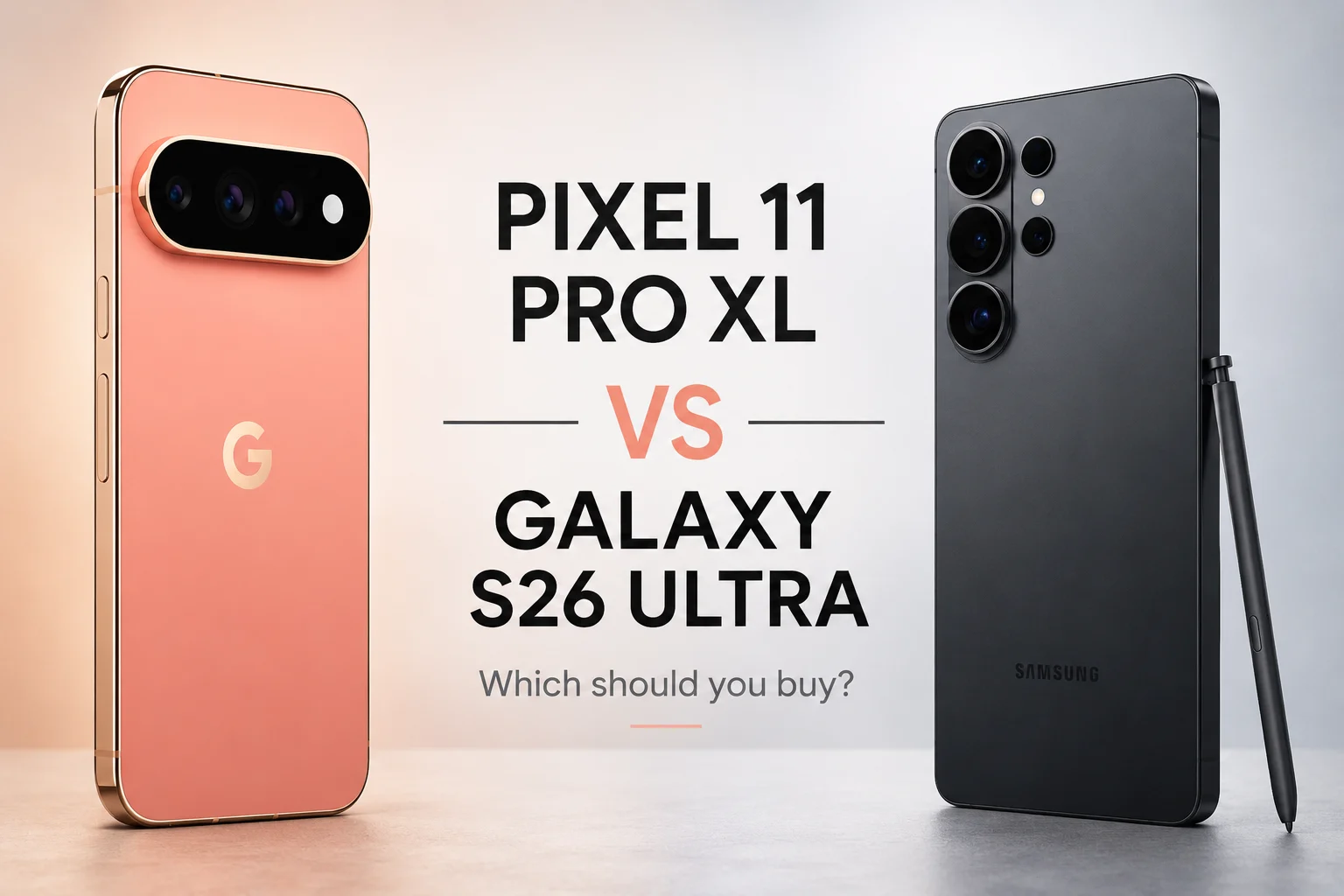
If you’re shopping for a flagship Android phone in 2026, the Google Pixel 11 Pro XL and Samsung Galaxy S26 Ultra are two of the obvious choices.
Samsung takes the “give me everything” approach: huge display, S Pen, four rear cameras, serious performance and more features than most people will ever discover.
Google takes a different route. The Pixel 11 Pro XL focuses on Google’s clean Android experience, photography, Gemini integration and the way its hardware and software work together.
Both are excellent phones. But they’re excellent for different reasons.
Pixel 11 Pro XL vs Galaxy S26 Ultra: Key Specs
| Specification | Pixel 11 Pro XL | Galaxy S26 Ultra |
|---|---|---|
| Display | 6.8″ LTPO OLED, 1–120Hz | 6.9″ Dynamic AMOLED 2X, 1–120Hz |
| Processor | Google Tensor G6 | Snapdragon 8 Elite Gen 5 for Galaxy |
| RAM | 12GB / 16GB | 12GB / 16GB |
| Main Camera | 50MP | 200MP |
| Telephoto | 48MP 5x | 50MP 5x + 10MP 3x |
| Maximum Zoom | Up to 120x Pro Zoom | Up to 100x |
| Battery | 5,115mAh | 5,000mAh |
| Fast Charging | Up to 75% in ~30 min | Up to 75% in ~30 min |
| Wireless Charging | Pixelsnap Qi2.2, up to 25W | Wireless charging |
| Special Feature | HiLight | Privacy Display + S Pen |
| Weight | 226g | 214g |
Specifications tell us something. They don’t tell us which phone you’ll actually enjoy using.
Display & Design
Both phones have excellent LTPO displays with adaptive refresh rates up to 120Hz. The Pixel gives you 6.8 inches and up to 3,600 nits peak brightness, while Samsung gives you a slightly larger 6.9-inch panel.
Interestingly, despite being larger, the S26 Ultra is also lighter: 214g versus 226g for the Pixel.
Twelve grams doesn’t sound like much until you’re lying in bed and drop your flagship phone directly onto your face.
Samsung also has something completely new this year: Privacy Display.
It reduces how much of the screen people can see from an angle and can even be configured for specific apps, notifications or password entry.
It’s clever, but we’re not completely sold on it. There have been concerns around the effect the technology can have on perceived sharpness and display quality, and Samsung itself acknowledges that image quality can change outside the normal viewing angle.
Useful? Absolutely.
Perfect? Not quite.
And regardless of how clever the display becomes, we’d still protect a phone this expensive with good tempered glass.
Performance: Benchmarks Don’t Tell the Whole Story
On raw performance, Samsung has the advantage.
The Snapdragon 8 Elite Gen 5 for Galaxy is considerably stronger in benchmarks and especially in GPU-intensive tasks. If you’re a serious mobile gamer or simply want maximum performance, the S26 Ultra is the obvious choice.
But there’s another side to this.
Google doesn’t build Tensor purely to win benchmark competitions. The Tensor G6, Android, Pixel software and Gemini are designed as one platform, and Google says the new processor improves app launches, browsing and on-device AI performance.
In everyday use — WhatsApp, Chrome, email, photos, Maps, social media — both phones are extremely fast.
So yes, Samsung wins Geekbench.
Whether you’ll celebrate that victory every time you open WhatsApp is another question.
The Pixel’s biggest strength remains the clean Google Android experience. If you prefer Google’s approach to Android without Samsung’s huge additional feature layer, that’s a genuine reason to choose it.
Cameras: 200MP Doesn’t Automatically Mean Better Photos
Samsung comes armed with a 200MP main camera, 50MP ultra-wide and two telephoto cameras.
Google uses a 50MP main camera, 48MP ultra-wide and 48MP 5x telephoto.
On paper, Samsung wins easily.
In reality, things aren’t that simple.
The S26 Ultra offers greater camera flexibility, particularly with zoom. It’s the better choice if you enjoy having multiple focal lengths and more control over how you shoot.
Pixel’s strength remains point-and-shoot photography. Google’s image processing has always been a major part of the Pixel experience, and the Pixel 11 Pro XL combines upgraded sensors with Tensor G6 processing.
Google also offers Pro Zoom up to 120x.
That’s technically more than Samsung’s 100x, but let’s not get carried away. At 100x or 120x, both phones are asking a considerable amount of software and AI to help create the final image.
Nobody should choose a €1,000+ phone because 120 is a bigger number than 100.
For camera versatility: Samsung.
For simple point-and-shoot photography: Pixel is extremely hard to beat.
HiLight: A Great Idea Google Hasn’t Finished Yet
One of the Pixel 11 Pro XL’s most interesting additions is HiLight.
The LEDs around the camera flash can display different light patterns while the phone is face-down, allowing you to see certain information without turning on the screen.
We actually really like the idea.
The problem is that Google has been very… Google about the implementation.
At launch, HiLight is fairly limited. It can interact with things such as Gemini and calls from favourite contacts, but it isn’t yet the fully customisable notification system we’d like it to be.
In other words, Google has reinvented the notification LED.
It looks much cooler now. It just needs more things to notify us about.
Hopefully that changes with software updates.
Battery, Charging & Pixelsnap
Battery capacities are very close: 5,115mAh on the Pixel versus 5,000mAh on the Samsung.
Both can reach around 75% in approximately 30 minutes with the appropriate charger, although Samsung supports up to 60W wired charging.
The more interesting Pixel feature is Pixelsnap.
Google has built Qi2.2 magnetic charging directly into the Pixel 11 Pro XL, supporting up to 25W wireless charging and magnetic accessories.
It’s one of those features that doesn’t sound revolutionary on a specification sheet but becomes genuinely useful once you start using magnetic chargers, stands and accessories every day.
An Important Note for Pixel Buyers in Cyprus
There’s one issue international comparison articles probably won’t tell you about.
5G works on Pixel devices in Cyprus, but we’ve encountered problems with VoLTE on a major Cyprus mobile network.
From our own experience and reports we’ve received from Smartech customers, enabling VoLTE on some Pixel devices has caused unusual behaviour when calling certain special numbers. In some cases, calls have been incorrectly directed to 112 instead.
We’ve experienced this ourselves on a previous Pixel Pro XL generation.
We’re deliberately not speculating about the technical cause or pointing fingers at either the device manufacturer or network. But it is something Pixel buyers in Cyprus should know about.
For normal everyday network compatibility in Cyprus, Samsung currently provides the more trouble-free experience in our experience.
So Which One Should You Buy?
Choose the Galaxy S26 Ultra if you want maximum performance, greater camera flexibility, the S Pen, Samsung’s extensive feature set and stronger local network compatibility.
Choose the Pixel 11 Pro XL if you prefer Google’s Android experience, excellent point-and-shoot photography, deep Gemini integration, Pixelsnap and the overall simplicity of the Pixel ecosystem.
Neither phone wins everything.
And that’s probably the most useful thing we can tell you.
Smartech Expert Opinion
If you’re asking us which is the more complete phone, we’d give the advantage to the Galaxy S26 Ultra. Its performance, camera flexibility, S Pen and mature feature set make it extremely difficult to beat.
But that doesn’t automatically make it the phone we’d recommend to everyone.
The Pixel 11 Pro XL has character. Google’s clean Android experience, excellent photography and tight integration between Tensor, Android and Gemini make it feel different from most other Android flagships. Pixelsnap is genuinely useful, and HiLight has plenty of potential — even if Google hasn’t made full use of it yet.
Our biggest hesitation recommending the Pixel in Cyprus isn’t its benchmark performance. It’s the VoLTE behaviour we’ve encountered locally.
Our advice?
Don’t choose based on megapixels, benchmark scores or which phone has the longest feature list. Choose based on the features you’ll actually use every day.
And if you’re still undecided, that’s exactly the kind of question we’re happy to help with at Smartech.